

Pedro Lazzarotto
12 June 2026
A decade of Ubuntu on IBM Z and IBM LinuxONE
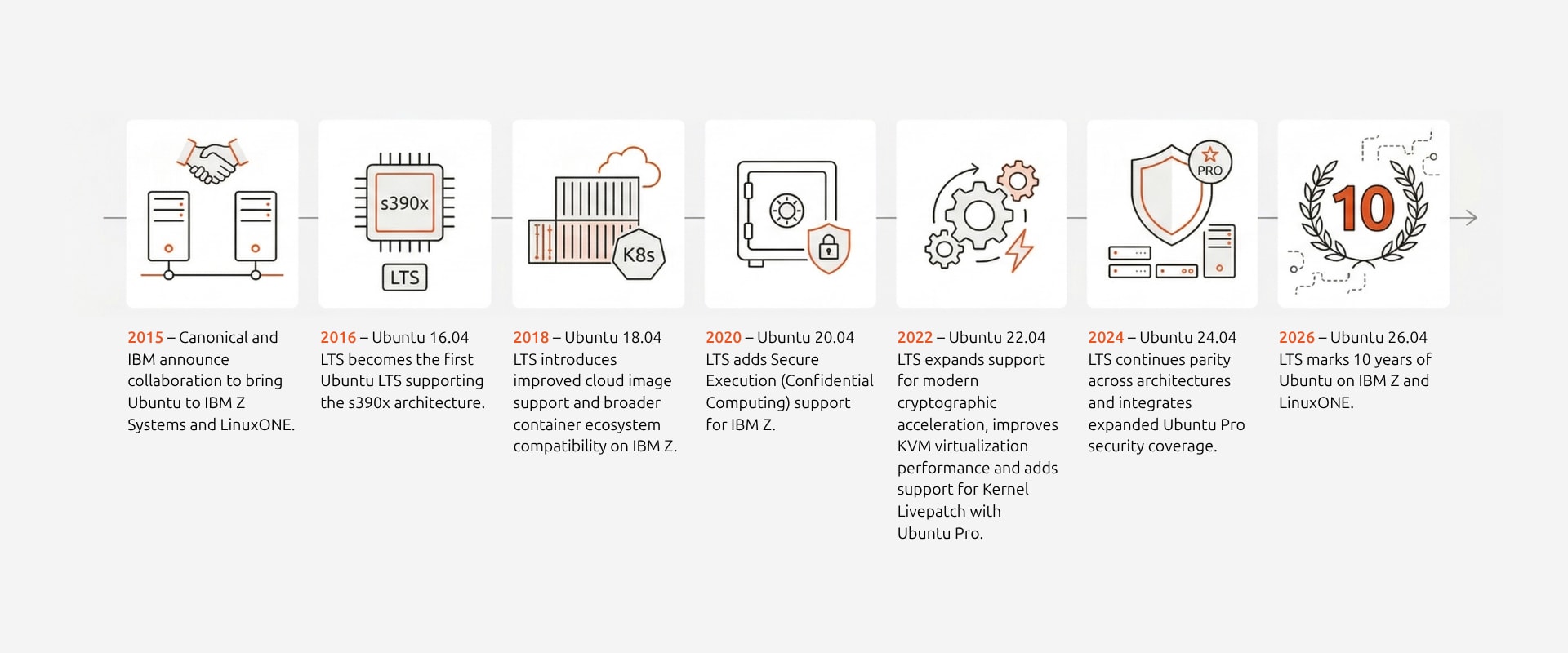
This year we celebrate a decade of Ubuntu Server support on the s390x architecture: marking a long-standing collaboration between Canonical and IBM that began at LinuxCon 2015. The first release happened on April 21, 2016, bringing Ubuntu 16.04 LTS (Xenial Xerus) to IBM Z and IBM LinuxONE platforms.
A first for Ubuntu on IBM
That release was a significant milestone: for the first time, enterprises could deploy the vast Ubuntu ecosystem directly on IBM hardware. IBM Z and IBM LinuxONE platforms handle a significant portion of the world’s financial transactions, and power critical banking and healthcare systems. Native support ensured Ubuntu’s availability and long term sustainability for development and production workloads from day one, in environments that have some of the strictest security requirements.
Engineering for architecture parity
Canonical’s partnership with IBM allows organizations to modernize their mission-critical systems by bringing the Ubuntu developer ecosystem and Canonical’s enterprise support to IBM mainframes.
Through this collaboration, large enterprises can freely adopt open source tools and technologies. For example, Canonical provides Ubuntu Server images for traditional installations, cloud images for KVM, OpenStack, LXD, and other virtualized environments, as well as OCI images for cloud native environments. This makes it easier for developers and organizations to develop applications on a different architecture, porting them to the IBM platform once it’s time to go to production.
Ubuntu supports multiple deployment modes on IBM Z and IBM LinuxONE, including:
- LPAR (logical partitions)
- z/VM virtualization
- KVM
- LXD and OCI containers
These deployment models enable enterprises to efficiently run a large number of isolated Linux workloads on the same physical system, a core advantage of IBM’s scale-up architecture. In environments where servers are often underutilized, this improves resource utilization, addressing common challenges such as data center sprawl, rising power costs and server consolidation needs.
How we partner to bring Ubuntu to more architectures
Ensuring a consistent Ubuntu experience in new systems, hardware and architectures requires dedication. To achieve this, our engineers work closely with both IBM and upstream developers to avoid forks and maintain high software quality. Some of the key highlights from our decade of collaboration include:
- Maintaining s390-tools from version 1.34.0 to 2.41.0
- Delivering early support for Secure Boot on IBM Z and LinuxONE
- Enabling IBM Secure Execution (TEE) to protect data in use
At the same time, Canonical:
- Ships a new version of Ubuntu every 6 months, and an LTS version every 2 years
- Provides up to 15 years of support for LTS releases, one of the longest support life cycles in the market
- Maintains thousands of open source packages in a constantly growing ecosystem
Why should you use Ubuntu in your enterprise?
Ubuntu brings world-class open source software and enterprise-grade security and stability for the widest range of applications, use cases and industries. Through this partnership, IBM integrates Ubuntu as a strategic part of it’s ecosystem, providing a high-performance, secure, and efficient foundation for mission-critical workloads on IBM Z and IBM LinuxONE.
Here are some core reasons why Ubuntu excels in enterprise environments:
- Pervasive security: complements IBM hardware with support for Secure Execution (TEE) and end-to-end encryption for data at rest and in use
- Maximum uptime: supports features like Kernel Livepatch allowing critical updates to be applied between maintenance windows, eliminating disruptive downtime
- Streamlined compliance: simplifies regulatory requirements for the public sector through built-in support for FIPS and other industry certifications
- Future-proof cryptography: integrates quantum-safe algorithms (ML-KEM and ML-DSA) via the Crypto Express 8S module to protect against evolving digital threats
- Expanded security maintenance: with Ubuntu Pro, organizations get long-term stability with security patches for thousands of open source packages.
AI future-ready
Canonical is also working with IBM to ensure Ubuntu Server fully leverages the latest hardware technologies from IBM, including the IBM Telum® II processor and the IBM Spyre™ Accelerator. In that context, Ubuntu serves as the foundational ecosystem for modern AI development on IBM Z and IBM LinuxONE, bridging the gap between raw compute, multi-platform support, enterprise scale, and production-ready AI workloads. With a consistent environment across workstations and clouds, engineers and researchers can quickly transition from development to large-scale training and inferencing.
What the future holds
It has been a successful 10 years with significant technical advancements, and we look forward to the next decade, and more. This collaboration has established a reliable path for enterprises to run Linux and Ubuntu on IBM infrastructure.
Today, Ubuntu continues to be fully certified across multiple generations of IBM Z and IBM LinuxONE systems, including IBM z17 and IBM LinuxONE 5, ensuring compatibility with modern enterprise hardware and cryptographic capabilities. As enterprise needs shift toward AI workloads, hybrid cloud architectures, and quantum-safe security, our unified stack provides the foundation required for the next decade of mission-critical computing.
Download Ubuntu Server for IBM Z and LinuxONE
Or if you have any questions, contact us directly.


